
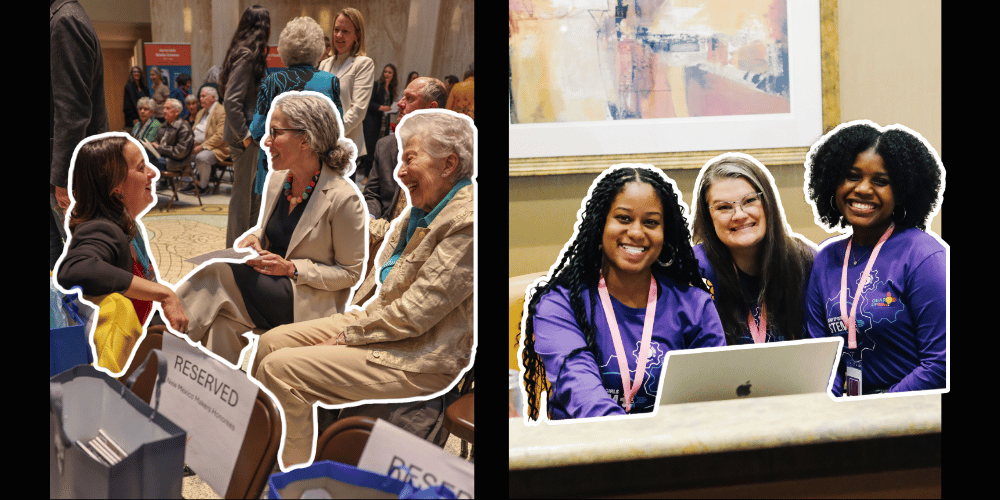
Women Are Driving Nonprofit Impact. Marketing Has a Role in Closing the Equity Gap.
Women are doing the work.
Across the nonprofit sector, women lead programs, manage community partnerships, design solutions, and carry mission-critical operations forward. In education, conservation, financial social impact, healthcare, and community development, women are often the backbone of service delivery.
Yet funding patterns tell a different story.
Research from Triple Pundit (2024) and The Women’s Philanthropy Institute (2025) continues to show that women-led nonprofits and gender-diverse leaders receive a disproportionately small percentage of philanthropic dollars. Women are overrepresented in frontline roles but underrepresented in executive funding authority and major grant allocation.
As a nonprofit marketing agency working with purpose-driven organizations, we are not financial experts. But we are deeply embedded in this ecosystem. And from our vantage point, one thing is clear:
Narrative shapes capital.
Gender equity in philanthropy is not just a funding issue. It is a visibility issue. A positioning issue. A power issue.
The Funding Gap Is Real. So Is the Narrative Gap.
The philanthropic funding gap for women-led nonprofits is well documented. But what is less discussed is how storytelling, branding, and nonprofit marketing influence whose work is seen as scalable, strategic, and investment-worthy.
In our work supporting nonprofits across education, conservation, and financial social impact, we see patterns:
-
Organizations led by women are often deeply community-rooted but under-positioned as “thought leaders.”
-
Programmatic excellence is strong, but narrative framing underplays innovation.
-
Impact reporting exists, but it is not always translated into compelling, funder-ready storytelling.
Funders make decisions based on data. But they also make decisions based on perception.
And perception is shaped by communication.
Nonprofit Marketing as an Equity Lever
When we talk about gender equity in philanthropy, the conversation often centers on funding models and institutional reform. Those conversations are essential. But marketing has a role to play.
Social impact marketing influences:
-
Who is seen as visionary.
-
Whose leadership is amplified.
-
Which organizations are perceived as scalable.
-
How innovation is communicated.
-
How outcomes are framed.
Visibility drives credibility. Credibility influences investment. Investment shapes impact.
When women-led nonprofits are positioned as strategic architects of systems change rather than solely service providers, the narrative shifts.
And narrative shifts can influence funding behavior.
Purpose-Driven Funding Requires Strategic Communication
Purpose-driven funding is most effective when it aligns with lived experience and community proximity. Research from the Lilly Family School of Philanthropy (2024) reinforces that gender-equitable philanthropy strengthens organizational resilience and long-term outcomes.
From a marketing perspective, this means:
-
Elevating leaders closest to the work.
-
Framing lived experience as expertise.
-
Showcasing measurable impact without minimizing relational leadership.
-
Communicating infrastructure needs alongside program results.
Too often, nonprofit marketing focuses solely on storytelling that evokes empathy rather than storytelling that communicates strategy.
Women are often expected to be relational leaders. They are less frequently positioned as structural strategists. That narrative bias has implications.
If we want funding to align more equitably, communication strategies must evolve.
What Social Impact Marketing Can Do
As marketers, we cannot rewrite funding policy. But we can:
-
Amplify women leaders as experts and visionaries.
-
Design messaging frameworks that position organizations as long-term systems builders.
-
Translate data into compelling narratives that resonate with institutional funders.
-
Elevate decision-makers’ proximity to community impact.
-
Strengthen thought leadership visibility across digital platforms.
In our own Women’s History Month campaign, we are highlighting women we are proud to work alongside. These leaders are not side stories. They are architects of measurable change.
Our goal is not symbolic celebration. It is narrative recalibration.
When women-led nonprofits are consistently positioned as innovative, strategic, and scalable, we contribute to a broader shift in how leadership excellence is perceived.
Equity Is About Power. Marketing Shapes Power.
Our recent campaign said it clearly: equity is not just about who is at the table. It is about who has power.
Marketing shapes who is visible at that table.
Who is invited to speak on panels.
Who is quoted in articles.
Who is perceived as funder-ready.
Who is seen as the “face” of innovation.
Gender equity in philanthropy cannot exist without narrative equity.
If communication strategies continue to under-position women-led organizations as thought leaders, funding inequities will persist.
A Call to Nonprofits and Funders
For nonprofit leaders:
Invest in positioning.
Invest in strategic storytelling.
Invest in marketing infrastructure that communicates scale and long-term vision.
For funders and government partners:
Consider how visibility patterns influence your perception of leadership.
Examine which narratives are consistently elevated.
Support capacity-building investments that strengthen nonprofit marketing alongside program funding.
Women are already driving impact.
As social impact marketers, we believe communication can either reinforce systemic imbalance or help dismantle it.
We choose the latter.
This Women’s History Month, we are not just celebrating women in nonprofit leadership. We are amplifying them intentionally, strategically, and visibly.
Because equity in funding begins, in part, with equity in narrative.